Landscaping, Lawn Care & Irrigation Services in Seminole, TX

Seminole is the Gaines County seat, about 80 miles southwest of Lubbock at the junction of US-62, US-180, US-385, and SH-214. Ace Landscaping provides lawn care, landscaping, hardscaping, irrigation, sprinkler repair, and yard drainage to Seminole homes, farms, and businesses.

  • Same-week scheduling for estimates and service calls
  • Texas Licensed Irrigator on all irrigation and sprinkler work (TCEQ)
  • All services: lawn care, landscaping, hardscaping, irrigation, sprinkler repair, drainage
  • Written quote on every job · No open-ended estimates

Open Today

7+

Years of Experience

4.8

Google Rating

740+

Land Care Projects

Downtown Seminole, TX near the Gaines County Courthouse

Seminole’s Sandy Soil and High-Wind Climate Change What a Yard Needs

Gaines County sits over notably sandier ground than most of the South Plains, soil good enough to make the county Texas’s number-one peanut producer. That sandy profile drains fast and holds less moisture and fewer nutrients than the caliche-capped clay loam found closer to Lubbock, so lawns and new plantings here need lighter, more frequent watering and a different fertilization schedule instead of the deep, infrequent watering that works on heavier ground. We check soil texture and depth at each Seminole property rather than assuming the same caliche profile we’d find elsewhere on the South Plains.

Gaines County’s cold semiarid climate brings some of the sharpest temperature swings in the region; the area holds the official state record for the coldest temperature ever recorded in Texas, -23 degrees Fahrenheit, set in February 1933. Strong, steady wind moves easily across the open plains here, and on Seminole’s sandy soil that wind carries topsoil and mulch more readily than it would on heavier ground elsewhere in the region, a real factor in new sod and young tree establishment.

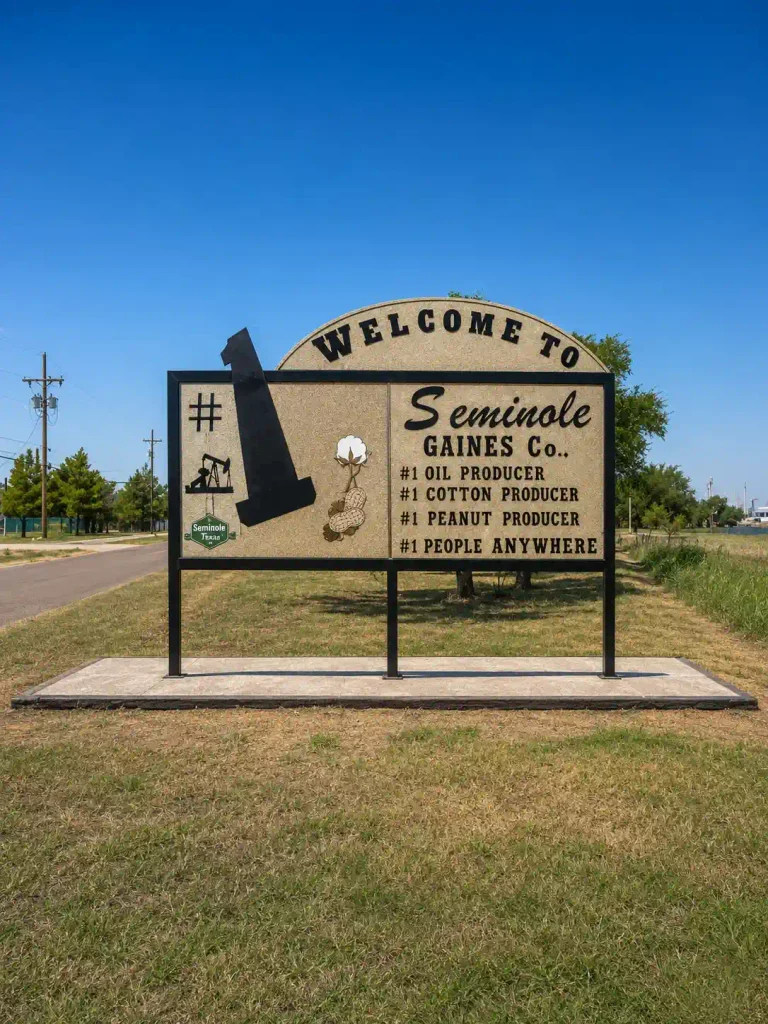
Gaines County is Texas’s number-one oil-producing, cotton-producing, and peanut-producing county, and Seminole sits at the center of that mixed Permian Basin oil-and-farm economy. A large Low German-speaking Mennonite farming community has worked the land southwest of the city since 1977, and many Seminole-area properties draw on well or agricultural water pulled from the Ogallala Aquifer in addition to, or instead of, municipal supply. We confirm the actual water source and pressure at each property before designing or repairing a system rather than assuming standard city pressure.

Seminole’s Historic Downtown Core and Newer Highway-Corridor Properties Face Different Problems

Many of Seminole’s oldest homes sit near the historic downtown and the Gaines County Courthouse, built up in the years after the city was established in 1906. Irrigation systems on these established in-town properties have often had decades to accumulate wear. Mature trees planted along original property lines have sent roots into lateral lines, and systems installed before recent hard freezes tend to carry layers of patch repairs rather than one coherent design. A full inspection on an older in-town Seminole property routinely turns up more than the single issue that prompted the service call.

Newer properties along Seminole’s outer edges, particularly near the US-62/180/385 highway corridors and toward the Mennonite farm country southwest of town, tend to be newer construction on graded, sandy ground with far less natural windbreak than the shaded in-town lots. These edge properties are also more likely to sit near oil-lease or cotton and peanut farmland, drawing partly on agricultural or well water rather than municipal supply alone. Sod and new plantings on these edge lots need a watering and staking plan built around open wind exposure and fast-draining sandy soil, rather than the mature-canopy shelter that helps the downtown core.

Serving Seminole and the Surrounding South Plains

We serve Seminole and 13 surrounding South Plains communities. Every property gets the same on-site assessment, written estimate, and Texas Licensed Irrigator oversight on all irrigation and sprinkler work.

Lubbock · Wolfforth · Shallowater · Plainview · Levelland · Slaton · Idalou · Abernathy · Littlefield · Lamesa · Brownfield · Post · Muleshoe

Every surrounding city receives the same on-site assessment, written estimate, and soil-specific approach that Seminole properties get.

Not sure if your address falls within our service area? Call (806) 230-9098 and we will confirm same day.

Landscaping and Lawn Care Services Available in Seminole, TX

  • Lawn Care Services — Recurring mowing, fertilization, pre-emergent weed control, and aeration adjusted for Gaines County’s sandy, fast-draining soil and steady West Texas wind. Properties near the farm and oil-lease edges of town see faster soil drying than in-city lots, which changes watering frequency recommendations before the first visit is ever scheduled.
  • Landscaping Services — Design and installation of drought-tolerant plants, turf, and garden beds suited to Seminole’s sandy soil and open wind exposure. Plant and windbreak selection accounts for the fast-draining ground and the reduced natural shelter that comes with bordering open farmland and oil leases instead of neighboring structures.
  • Hardscaping Services — Concrete and paver patios, walkways, fire pit surrounds, and outdoor kitchens for Seminole properties. Base preparation accounts for the sandy subgrade common across Gaines County and the freeze-thaw cycle that moves concrete and paver joints between West Texas’s cold winters and 100-degree summer heat.
  • Irrigation Services — New system installation, zone layout, and controller programming performed by or under a Texas Licensed Irrigator (TCEQ), plus seasonal winterization and spring startup. Because many Seminole properties draw partly on well or agricultural water from the Ogallala Aquifer, we confirm the actual water source and pressure at each property before designing a system rather than assuming standard city pressure.
  • Sprinkler System Repair — Full inspection and repair of heads, valves, controllers, and backflow preventers, including freeze-damage repair after hard South Plains winters. Older in-town Seminole systems, some installed decades ago, often reveal more than one failure point once a complete inspection is done rather than just the symptom that prompted the call.
  • Yard Drainage — French drain installation, regrading, and runoff correction for Seminole properties. Even with Gaines County’s fast-draining sandy soil, low spots and compacted ground around driveways and outbuildings still hold water after heavy rain, so drainage has to be engineered into the property rather than relying on grade alone.

Frequently Asked Questions

Yes. Fall winterization shuts down and blows out the system before the first hard freeze, protecting valves, backflow preventers, and lateral lines from cracking. Spring startup re-pressurizes the system, checks every zone and head, and confirms the controller schedule is set correctly for the new season. Both are quick visits and are the single most effective way to prevent the freeze damage that causes zone failures each spring.

Yes. We build concrete and paver patios, walkways, fire pit surrounds, and outdoor kitchens for Seminole properties. Every project starts with checking the soil profile at the build site, since base preparation on Gaines County’s sandy ground works differently than on the caliche hardpan found elsewhere on the South Plains, and still has to account for freeze-thaw movement through West Texas winters. You’ll get a written, itemized estimate before any work is scheduled.

Recurring lawn mowing runs $40 to $80 per visit depending on lot size, and properties on Seminole’s outer edges near farm and oil-lease land often run toward the higher end given the larger lots common out there. Landscape bed installation runs $8 to $15 per square foot, and sod installation runs $1.50 to $3.50 per square foot. Fertilization is priced per treatment. Every job gets a written estimate on-site before work is scheduled — no phone quotes followed by a higher invoice.

Yes. Many Seminole-area properties draw on well or agricultural water sources pulled from the Ogallala Aquifer, in addition to, or instead of, municipal supply, including properties in and around the Mennonite farming community southwest of the city. We confirm the water source, pressure, and flow rate at each property before designing or repairing an irrigation system, since a system built for standard city pressure won’t perform correctly on a different source.

Gaines County’s soil is notably sandier than the caliche-capped ground found through most of the South Plains, part of why the county leads Texas in peanut production. That sandy soil drains fast and holds less moisture and fewer nutrients than heavier clay-loam soil, so new sod and young plants dry out faster and need lighter, more frequent watering rather than the deep, infrequent schedule that works elsewhere. Wind exposure on open edge lots compounds the problem by drying the topsoil surface even further. We build the watering and staking plan around the actual soil texture and wind exposure at each property rather than a standard schedule.

Yes. We handle lawn care, landscaping, irrigation, and hardscaping for Seminole businesses, oil and gas field facilities, cotton and peanut operations, and HOA common areas, with the same written, itemized estimates provided for residential work. Call (806) 230-9098 to schedule a commercial property walk.